Total and its colonial legacy face resistance worldwide

The world’s fourth-largest oil and gas company, Total, has built a neocolonial empire around the extraction of fossil fuels. Extraction, predation and human rights violations seem to be the transnational corporation’s (TNC) modus operandi. Drawing from its colonial history, especially in Africa and the Middle East, Total takes from resource-rich Global South countries to generate profits that are then exported to rich countries. As for the devastating environmental, climate, social and economic impacts, accountability and justice for those affected remain largely out of reach.
Stronger human rights, environmental, climate or labour regulations, as they may ultimately threaten profits, remain a hard-fought battle. Led by those on the frontlines of a global economic system that enables and encourages Total’s actions, however, movements and peoples from across the globe are internationalising hope as they continue the struggle for justice.
Mozambique LNG and Total’s colonial framework
Total’s history is rooted in the colonial history of France, and its operations today are a reflection of this. Established in the aftermath of World War I, the French government backed the creation of the Compagnie française des pétroles, a private company, to develop a national oil policy. This was eventually rebranded to become Total. The company expanded aggressively across France’s colonies, particularly in North and West Africa.
In places like Algeria, large-scale extraction projects were developed within a colonial framework that prioritised supplying energy to France to the detriment of local communities.
The resources of the French state, including its economic diplomacy, have been put to the service of Total to help it expand globally, particularly across Africa. As anti-France sentiment grew in recent decades in francophone Africa (due to the brutal and ongoing legacy of French colonialism there), Total also started expanding to other countries in the region where it didn’t have such a historical tie. These neocolonial operations today are exemplified by the case of Total’s Mozambique Liquefied Natural Gas (LNG) project in the Cabo Delgado region.
Mozambique LNG aims to open deep-water gas fields to extract LNG, which will then be transported via underwater pipeline to be liquefied in a massive on-land industrial park.
Human rights organisations and local communities have compiled evidence regarding land acquisition, mass displacement of coastal communities, loss of livelihoods, environmental degradation and human rights violations. The project’s impacts could be devastating and irreversible, including to the surrounding area’s critically endangered species and unique ecosystems of the Quirimba’s archipelago, a UNESCO Biosphere Reserve. The expansion of the extractive industry, particularly gas and rubies, has exacerbated pre-existing feelings of exclusion, socio-economic inequalities, and historically entrenched territorial and inter-community disputes, contributing to the emergence of armed conflicts led by insurgent groups. Total has gone as far as to finance a special security force of Mozambican soldiers to protect its facilities, bringing into question Total’s complicity in related war crimes. The gas infrastructure is also understood as a main target of the insurgency, putting communities at further risk.
And where is all that gas going? Although extracted and processed in Mozambique, it is not primarily intended to meet local energy needs. Instead, it is designed for export. It will eventually be shipped to international markets, to the primary benefit of shareholders.
Sacrificing communities, exporting profits
Total’s operations reflect a global colonial economic system wherein countries rich in natural resources are forced to remain dependent on exporting raw materials while importing finished products at higher prices. Wealth flows outward while communities living closest to extraction sites often continue to experience poverty, environmental degradation, human rights violations and limited public services.
In other words, the extraction of fossil fuels has always depended on unequal exchanges between resource-producing regions and wealthy consuming nations. Oil, coal and gas extracted from the Global South generate enormous corporate profits that ultimately benefit investors and financial institutions in the Global North.

The injustice becomes even more apparent in the context of the climate crisis, as those most vulnerable and who have contributed the least are most impacted. Communities across the Global South as well as marginalised communities in the Global North who are already experiencing the consequences of extraction are confronted with further injustice.
Mozambique, which now lies at the frontier of fossil gas expansion in the hands of Total and other TNCs, is also one of the countries most vulnerable to the climate crisis, experiencing extreme weather events like cyclones, massive floods and droughts almost every year.
“This is why we’re fighting for a strong and effective UN Binding Treaty, to make sure transnational corporations are regulated. Affected communities in Cabo Delgado and across the world are resisting and denouncing destructive and neocolonial energy projects, demanding their right to say no.”
Erika Mendes, Justiça Ambiental JA! / FoE Mozambique
The neocolonial dynamics that transnational corporations like Total rely on are therefore intertwined with the climate crisis, environmental degradation and human rights violations.
While these corporations centre profits, our solutions must centre peoples. In other words, there can really be no climate justice nor sovereignty without the dismantling of corporate power and an end to corporate impunity.
Towards a UN Binding Treaty
These neocolonial transnational corporations, like Total, have structured themselves to operate across multiple legal jurisdictions, creating an enormous challenge for accountability and justice for affected communities.
A company can be headquartered in one country, financed in another, registered through subsidiaries elsewhere, and operate projects across several additional states. As a result, communities affected by environmental damage or human rights violations like those in Mozambique frequently encounter legal barriers, high litigation costs and unequal access to justice.
So just as transnational corporations operate globally, legal accountability and solidarity must also extend beyond borders.
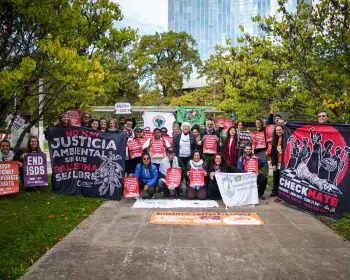
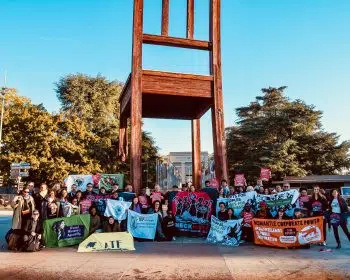
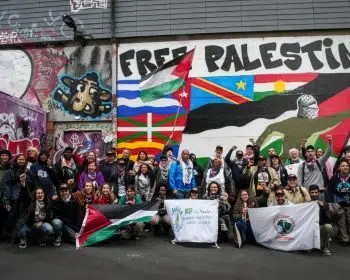
This is why movements and organisations like Friends of the Earth International, Justiça Ambiental JA! / FoE Mozambique, FoE France, affected communities and Indigenous Peoples on the frontlines of corporate power are calling for an international legally Binding Treaty on transnational corporations and human rights.
The Binding Treaty would establish clear obligations for TNCs, strengthen mechanisms for corporate accountability, ensure access to justice for affected communities, and help prevent corporations from dodging responsibility.
Neocolonialism today appears through economic relationships in which wealth, resources and decision-making power continue to flow from the Global South to the Global North. Challenging these dynamics requires more than exposing individual projects. It demands transforming the international rules that allow corporate power to go unchecked, at a huge cost to our climate, environment, sovereignty and human rights.
Communities resisting projects like Mozambique LNG have repeatedly demonstrated that local struggles are connected to these global systems of finance, trade and consumption. Building international solidarity is therefore essential not only to support those affected but to challenge the structural inequalities that continue to shape the global economy.
Only when communities have meaningful power over the resources in their land, and corporations can be held accountable wherever they operate, can the legacy of extraction begin to really give way to a more just and equitable future. At a global level, this battle is being fought in the negotiations towards an urgently needed UN binding treaty on transnational corporations – led by and rooted in the everyday struggles of communities like those in Cabo Delgado.